
PIG E. BANK RISK MODELING
This project explores how predictive analytics can safeguard lending operations by identifying fraudulent behavior, reducing risk, and enhancing decision-making in the banking sector.
🔍 Project Overview
Pig E. Bank’s goal was to strengthen its risk management system by analyzing historical transaction and customer data to predict high-risk behaviors. Using Python and machine learning, this project aimed to develop an effective fraud detection model that could classify potential risks before damage occurred.
✅ Objective
To build a predictive model that flags risky loan applications and fraudulent accounts using transaction patterns and customer behavior.
🚩 Problem Statement
Pig E. Bank faced growing fraud-related losses due to insufficient early-warning systems. They needed a data-driven approach to proactively detect anomalies in transaction and profile data before approving loans or account activity.
🧠 Hypothesis
Customers flagged with specific transactional patterns (e.g., sudden high withdrawals, irregular deposits, or multiple accounts) are more likely to be involved in fraud or default, and machine learning can learn to detect such patterns effectively.
📊 Key Questions Explored
-
Can we build a model that accurately classifies high-risk customers?
-
What features (age, transaction type, location) are most predictive of fraud?
-
How do true positives and false positives affect decision-making?
-
Which algorithm (logistic regression, random forest, etc.) performs best?
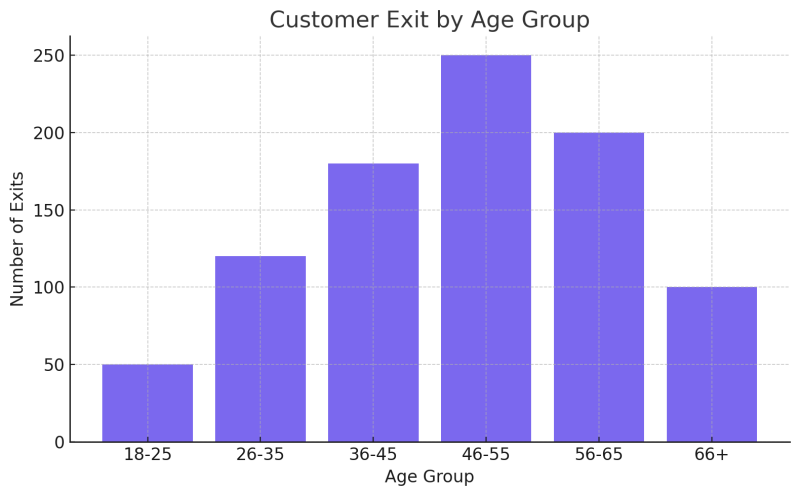
Customer Exit by Age Group

Decision Tree – Exit Risk Prediction
Key Findings
-
Fraudulent behavior is often signaled by specific transaction patterns and demographic combinations.
-
Machine learning models significantly outperform manual rule-based detection.
-
Reducing false positives is crucial to avoid unnecessary customer restrictions.
💡 Recommendations
-
Deploy the random forest model in the pre-approval stage to flag high-risk applicants.
-
Monitor flagged transactions in real time to prevent fraudulent withdrawals.
-
Educate customers about safe banking practices through targeted communication.
-
Periodically retrain the model to adapt to evolving fraud tactics.
Ready to Make Data-Driven Decisions?
Whether it's detecting risk, improving customer retention, or building smarter systems —
this project shows the power of combining analytics with action.